Aircraft co-ownership: how to split flying costs fairly
Annual contribution, hourly rate, reserves: which costs a shared aircraft brings, which models there are for splitting them and what you should put in writing.
Sharing an aircraft is the best way for many pilots to get their own. But when things get tense in a co-ownership, flying group or syndicate, it is often about money: who pays for what, and is it fair? I have flown in aircraft co-ownerships myself, and in this guide I show which costs come up, which models there are for splitting them and what to watch out for.
Which costs come up
An aircraft’s costs fall into two groups. Fixed costs come up no matter how much you fly:
- Insurance, such as liability and, if you want it, hull cover
- Hangar or parking
- Annual inspection and airworthiness review
- Fees and subscriptions, for example for navigation data
- Financing of the aircraft, if any
Variable costs depend on how much you fly:
- Fuel and oil
- Hour-based maintenance, such as the 50- and 100-hour inspections
- A reserve for engine and propeller overhaul
- Landing fees, unless each pilot pays them directly
Then there is the unexpected: a major repair, an avionics upgrade or damage. You need a rule for that before it happens.
Three common models
1. Annual contribution plus hourly rate
Every owner pays a fixed contribution, once a year or monthly, that covers the fixed costs. Whoever flies also pays an hourly rate for the variable costs. This is fair because the aircraft is equally available to everyone, and frequent flyers carry the higher wear. Those who fly little still pay the full fixed costs, though.
2. Hourly rate only
All costs are built into the hourly rate, with no fixed contribution. It is simple and suits owners who fly little. The catch: the fixed costs are spread over planned flight hours. If the group flies less than expected, money is missing at the end of the year, and everyone has to top up.
3. Split by ownership share
If the owners hold shares of different sizes, the fixed costs are often split by those shares, while variable costs are still charged by flight hours. That way everyone pays according to their share of the aircraft.
In my co-ownerships we used the first model: everyone made a one-off payment once a year, plus an hourly rate that included all other costs. Once a year we settled up and renegotiated the hourly rate for the following year.
Calculating the hourly rate
Concrete figures are of little help here, as they depend heavily on the aircraft, the country and the airfield. The way to get there is always the same:
- Estimate the annual costs: fixed and variable costs from the previous year or from quotes.
- Subtract the contributions: whatever the fixed contributions cover, the hourly rate doesn’t have to.
- Divide by the expected flight hours: estimate conservatively. Overly optimistic hours are the most common reason for top-up payments.
- Add a reserve per hour: the estimated cost of the engine overhaul divided by the hours remaining until it is due.
At the end of the year, compare the actual costs with the income and adjust the rate for the next year.
Wet or dry?
Wet means fuel is included in the hourly rate. Dry means every pilot pays for their own fuel. We always charged wet. It is simple, and nobody has to work out who added how much fuel. If someone refuels away from base and pays themselves, they get the amount refunded against a receipt. Dry has the advantage that the hourly rate stays stable when fuel prices fluctuate.
The tricky points
- What gets counted? Flight time, block time or the aircraft’s meter reading. Decide and stick with it. A meter reading leaves the least room for discussion.
- Occasional and frequent flyers: some groups agree on minimum hours or a minimum amount so the numbers still work in quiet years.
- Unplanned costs: is a major repair paid by a one-off payment from everyone or through a higher hourly rate? We discussed it case by case, and it was usually a one-off payment from everyone.
- Guests and outside pilots: if someone outside the group flies, they need their own rate that also covers a share of the fixed costs.
- Joining and leaving: how is a share valued when someone leaves or joins, and what happens to the reserves?
Put it in writing and review it every year
Write your rules down, ideally in your co-ownership agreement: the model, how the hourly rate is set, wet or dry, what gets counted and how you handle unplanned costs. Settle up once a year and adjust the rates. For legal and tax questions, such as the legal form of your group, get professional advice.
How apron:pilot helps
apron:pilot was originally built for aircraft co-ownerships. The logbook records every flight with flight time, block time and meter readings, already in the free version. With invoicing, that becomes your billing:
- Invoices straight from the logbook, with per-minute rates for each pilot, also based on meter readings
- The annual contribution as a custom invoice item
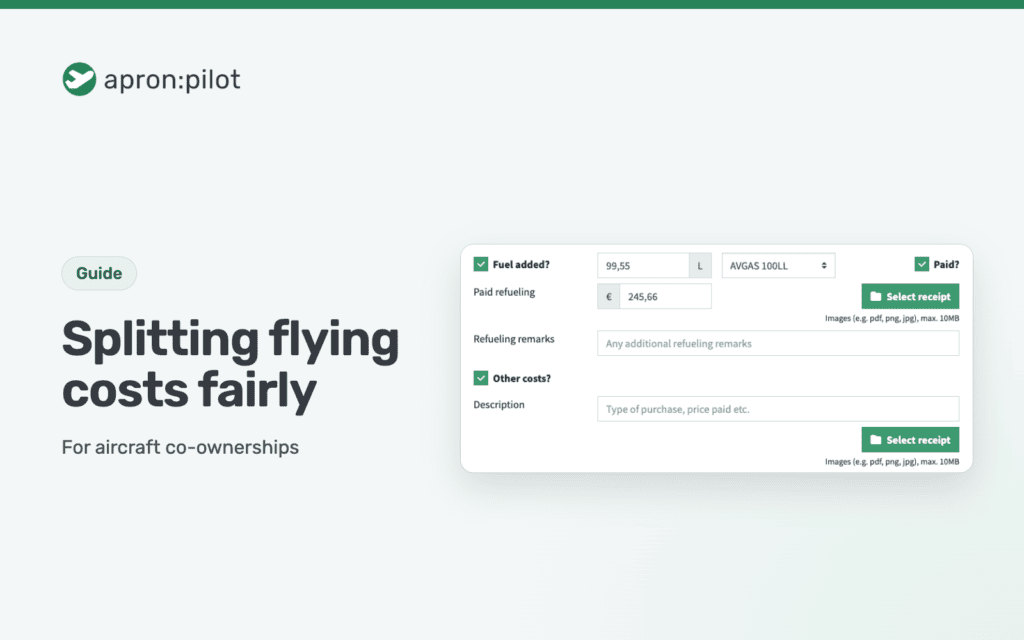
- Refuelled away from base: the pilot uploads the receipt in the logbook, and the amount is automatically offset in their invoice (from Advanced)
- Prepayments as credits
For the annual settlement, the statistics in Premium show who flew how much, and the logbook can be exported as XLSX. Learn more about how apron:pilot supports co-ownerships on the page for aircraft co-ownerships.
Frequently asked questions
How does an aircraft co-ownership calculate its hourly rate?
The estimated annual costs minus the fixed contributions, divided by the expected flight hours. Add a reserve per hour for engine and propeller overhaul. At the end of the year, compare with the actual costs and adjust.
Wet or dry rates: which is better?
Wet, with fuel included in the hourly rate, is simpler and avoids discussions about refuelling. Dry keeps the hourly rate stable when fuel prices fluctuate. Many co-ownerships charge wet and refund fuel paid away from base against a receipt.
Who pays for an expensive repair?
That should be set out in your agreement. Common options are a one-off payment from all owners or a higher hourly rate until the costs are covered. A reserve helps absorb such cases.
How often should a co-ownership settle up?
The flights themselves can be billed continuously, for example monthly. The overall review of costs and income, and adjusting the rates, is best done once a year.
Run your co-ownership digitally
Booking, logbook and billing in one place. Start free and upgrade when you need to.